From Reach-in to Room-Within-a-Room: What Today’s Wardrobes Can Do (That Your Old Closet Can’t)

The modern wardrobe is no longer just a hanging rod and a shelf behind a pair of doors. For both end users and industry professionals, it has become a fully planned storage system—often a room-within-a-room—that has to solve visibility, access, lighting, acoustics, and aesthetics all at once.
At Gregory Hitchcock Design, we treat wardrobes and walk-in closets with the same level of intent as kitchens and living spaces, using modular European systems to tailor each installation to architecture, lifestyle, and budget.
Most clients—and many projects—still think in terms of “a rod and shelves.” The current generation of wardrobe systems offers much more.
Truly modular planning
Contemporary systems allow us to design by module height, width, and depth, so closets can run wall-to-wall and floor-to-ceiling with millimeter-level fit instead of relying on filler pieces and afterthought carpentry.Multiple typologies in one language
Hinged-door wardrobes, sliding systems, and fully open “closet rooms” now share the same components, finishes, and internal accessories, so a project can mix reach-ins and walk-ins while staying visually consistent.Integrated lighting and accessories
LED profiles, pull-out shoe trays, glass-front drawers, and open display units are now part of the core system—not custom one-offs—which means we can specify them predictably across multiple rooms.
For industry partners, this means fewer custom details to engineer; for end users, it means the performance of a custom closet with the reliability of a tested system.
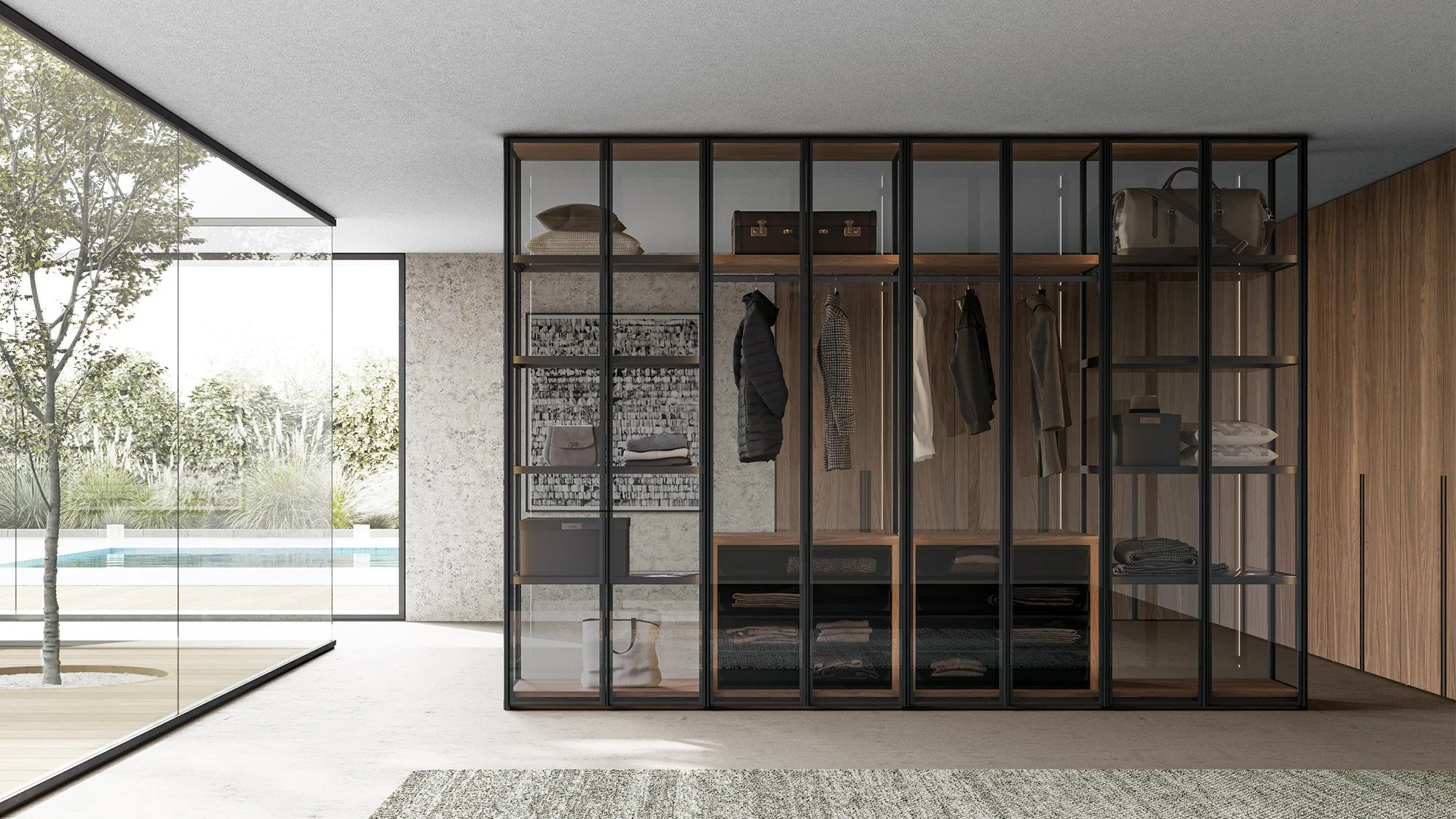
Designing Closets as Part of the Interior Architecture
We’ve found the most successful wardrobes are those planned alongside kitchens, baths, and built-ins, not after them.
In projects like Pawling NY Modern Country and Short Hills, wardrobes and walk-ins continue the same door language and finish palette used in adjacent rooms, so they feel like an extension of the architecture rather than an add-on.
In large primary suites—such as Pawling NY Horse Ranch—the closet becomes a transitional “dressing room” between bedroom and bath, with cabinetry heights, lighting, and mirrors all tuned to the circulation of the space.
By treating the wardrobe as a designed room, we can coordinate ceiling heights, bulkheads, and door openings with the system modules from day one, which simplifies construction and improves the final read of the space.
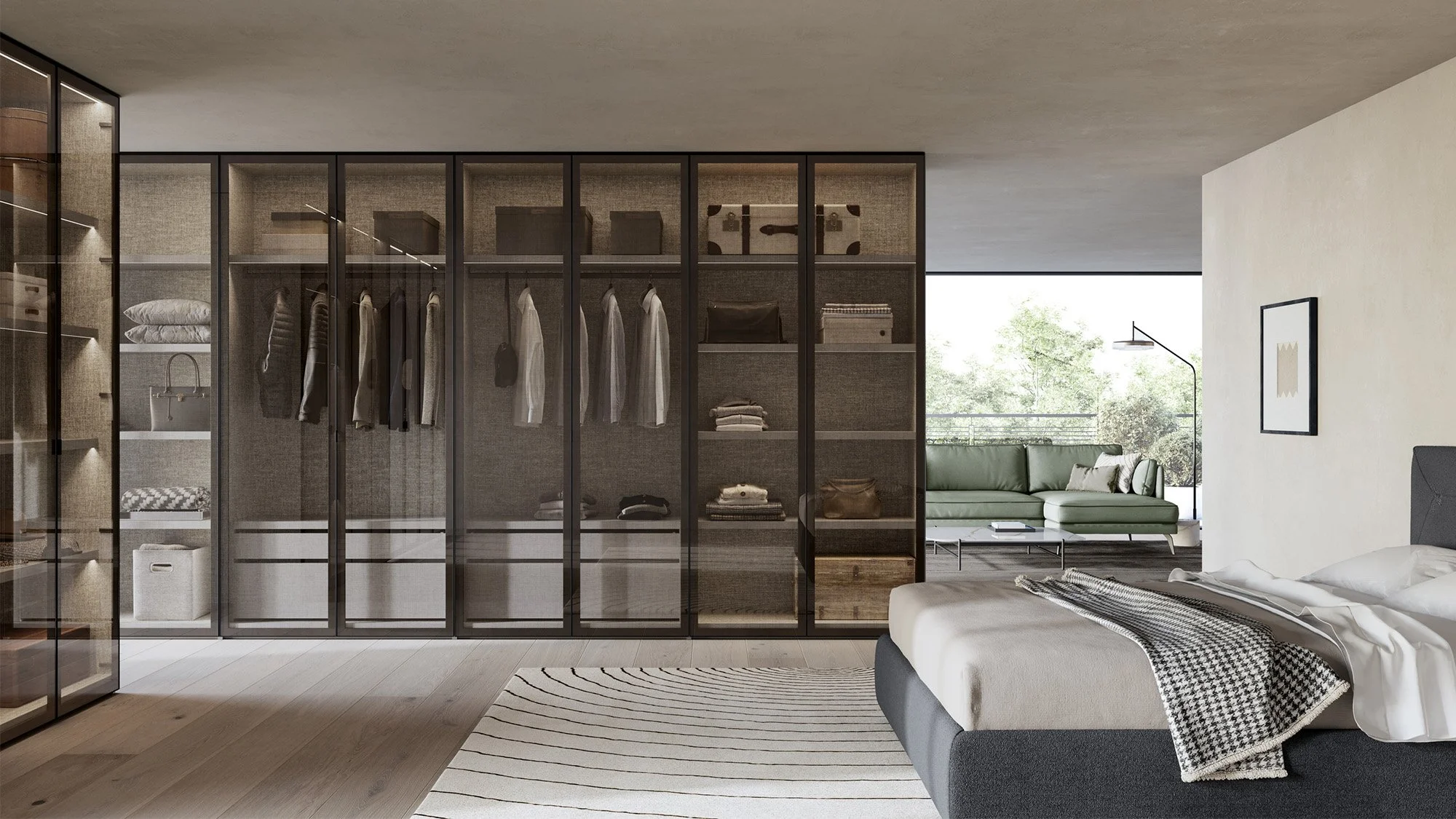
Use Cases for Builders, Architects, and End Users
Because these systems are modular and scalable, the same product family can address very different briefs.
Urban apartments
Shallow-depth or wall-mounted compositions make use of tight footprints, integrating wardrobes into circulation zones or media walls where every inch matters.Suburban primary suites and new builds
Full-height systems with a mix of closed storage and open display create boutique-style walk-ins, often combined with islands or benches for a more “room-like” experience.Guest and secondary bedrooms
More streamlined configurations can provide generous storage with a simplified accessory kit—same design language, fewer options—ideal for budget control on larger projects.
For professionals, this category allows you to standardize a design language across an entire home or multi-unit building, while still giving end users highly personalized interiors.
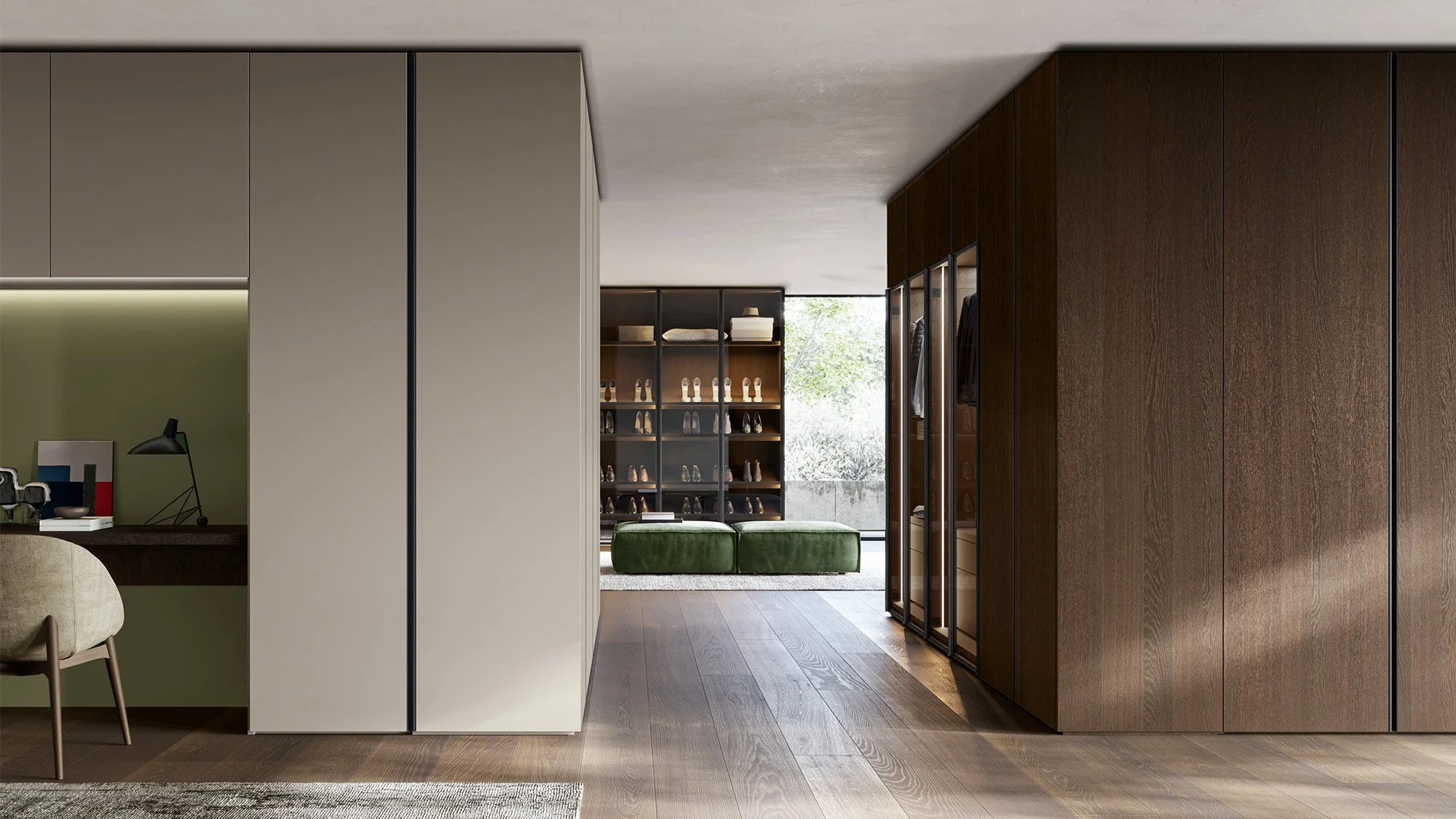
What We Bring to a Wardrobe or Walk-In Project
Whether you are an architect, builder, or homeowner, working with a studio deeply familiar with these systems matters just as much as the product itself.
We translate program and lifestyle needs—how many linear feet of hanging, how much folded storage, how much open display—into a precise modular layout.
We coordinate power, lighting, and adjacent finishes with the rest of the project so the wardrobe reads as part of a complete interior concept, not a separate “closet package.”
We leverage a broad material and accessory library to calibrate projects from efficient, rental-friendly solutions to highly finished, bespoke-feeling installations.
For end users, the result is a closet that works the way they live. For industry partners, it is a predictable, documentable category that can be repeated across projects with confidence.
If you’re planning a renovation or new construction project and want to elevate wardrobes and walk-ins from basic storage to a true part of the interior architecture, this is the moment to think of the category as a system—not just a box with a door.